Military Calisthenics for Women: A Beginner's Guide to Starting at Home
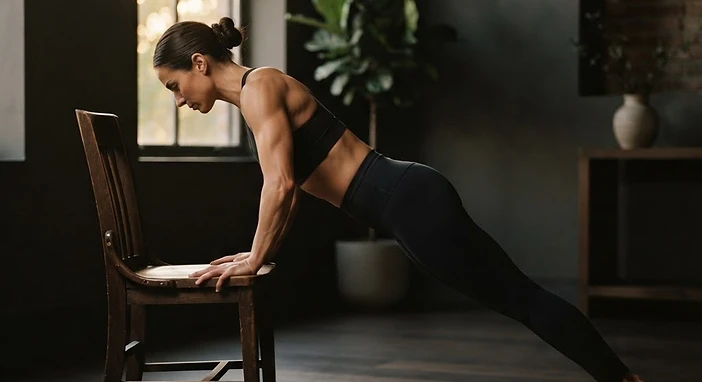
Military calisthenics for women is bodyweight training done in a military-inspired style: short scheduled sessions, timed sets, and disciplined progression rather than random workouts. It uses the same fundamental movements that work for anyone — push-ups, squats, planks, bridges — with an easier variation for every exercise, so a complete beginner can train at home with no equipment and finish each session cleanly.
What does "military" mean here?
In training terms, "military calisthenics" describes the style made famous by armed-forces fitness programs: simple bodyweight movements, performed to a schedule, with structure and consistency doing the heavy lifting. It is a style of training, not a claim about affiliation — MILITRO is a civilian fitness program inspired by that structure.
What that style gives you is the thing most home training misses: a plan. You know what today's session is, how long you hold each movement, and where the rest days fall. That structure is exactly what makes it beginner-friendly.
Is this kind of training suitable for women?
Yes — and for the same reasons it works for anyone. Bodyweight training builds strength and working muscle, and public-health guidance treats muscle-strengthening activity as a weekly requirement for all adults, not one gender: the CDC's physical activity guidelines recommend it on at least two days per week.
What you should be skeptical of is anything marketed as a special "fat-burning routine for women" — physiologically, strength training works the same for everyone, and a structured plan beats gendered gimmicks. There is no special version of a push-up for women; there are just easier and harder versions of a push-up, and everyone starts somewhere along that scale.
How the MILITRO program is structured
The MILITRO 28-day challenge ( full breakdown here) runs on a fixed calendar:
- 21 training days and 7 planned rest days spaced across four weeks
- Five movements per training day, each with written instructions and exercise videos
- Timed sets — week 1 is 2 sets of 20 seconds per movement, growing to 3 sets of 30 seconds by week 4
- An easier option for every movement, so the session always fits your current level
- Self-paced daily emails — you choose your start date, and the next session arrives only after you mark the current day complete
A warm-up before and a cool-down after every session are built into the plan, so nothing is left to guesswork.
How to start at home
- 1. Pick a start date and commit to it. A defined day one beats "eventually." The kit lets you choose your start date when you are ready.
- 2. Clear a small space. You need a patch of floor and, for some variations, a sturdy chair or sofa edge — nothing else.
- 3. Do the session as written. Warm up, work the five movements for the prescribed seconds, cool down. Week 1 sessions take about 10 minutes.
- 4. Mark the day complete. Completion is the habit you are building. Missed days happen — you simply continue where you left off.
Choosing the right exercise variations
This is the skill that decides whether a program works for you, and it is why every movement in the MILITRO kit ships with an easier option. A few examples from the program:
| Movement | If it's too hard today |
|---|---|
| Incline push-ups | Push-ups against a wall |
| Bodyweight squats | Sit-to-stand from a chair |
| Plank hold | Knee plank |
| Glute bridges | Shorter range, slower tempo |
| High knees | March in place |
The rule: drop to the easier version the moment your form breaks down — sagging hips, dropped chest, lifted heels. Clean, easier reps build more strength than struggling through hard ones, and as the weeks pass, the full movements arrive on their own. You can try a full beginner session for free to feel how this works in practice.
Every movement has an easier option built in.
Explore the MILITRO challengeHow to track your progress
For beginners, progress in calisthenics is mostly performance, not appearance — and it shows up quickly:
- Which variation you used — moving from wall push-ups to incline push-ups is real, measurable progress
- How long you hold — 20-second holds becoming comfortable is the program doing its job
- Days completed in order — the challenge's self-paced schedule tracks this for you, one confirmed day at a time
- How the sessions feel — the same session feeling easier in week 3 than week 1 is strength arriving
Everyone's timeline differs, and where you start depends on where you are today — that is precisely why easier options and timed sets, rather than prescribed rep counts, are the fairest way for a beginner to measure progress.
Common beginner mistakes
- Skipping the warm-up. It is one minute; it is in the plan for a reason.
- Training the hard version too soon. Ego selects the variation; discipline completes the session.
- Treating rest days as failure. Rest days are when the training settles in — seven of the 28 days are planned recovery.
- Comparing week 1 to someone's week 3. The only comparison that matters is your own last session.
Frequently asked questions
Is military calisthenics effective for women?
Yes. Bodyweight strength training builds muscle and strength the same way for women as for men, and public-health guidelines recommend muscle-strengthening activity on at least two days per week for all adults.
Do I need equipment to start?
No. The movements use only your bodyweight. You need a clear patch of floor and, for some variations, a sturdy chair or the edge of a sofa.
Can a complete beginner follow it?
Yes. Week 1 sessions are short — five movements, two sets of 20 seconds — and every movement has an easier option, so you always train at a level you can finish cleanly.
How long is a training session?
About 10 minutes in week 1, including the warm-up and cool-down. Sessions grow modestly as the sets and holds lengthen across the four weeks.
Explore the MILITRO challenge
Military calisthenics works for women the same way it works for anyone: structured sessions, movements you can scale, and a schedule that removes the daily decision of what to train. If that sounds like the missing piece, the product page has the full details, and what's inside the kit is broken down here.
Start at home, one 10-minute session at a time.
Get the kit