Military Calisthenics Workout: Exercises, Structure, and Progression
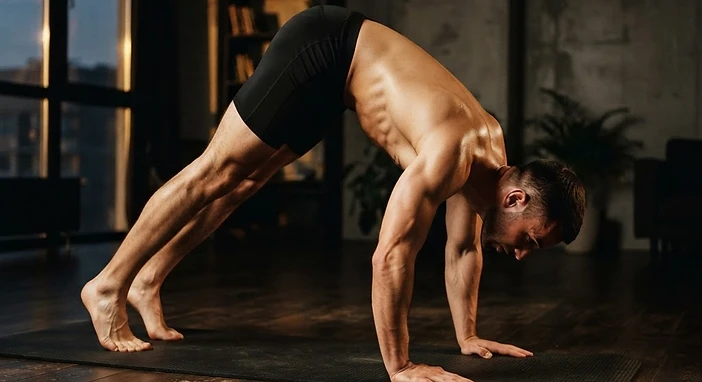
A military calisthenics workout is a full-body strength and conditioning session built entirely from bodyweight movements — push-ups, squats, lunges, planks, mountain climbers — organized into timed sets with fixed rest, structured warm-ups and cool-downs, and planned week-by-week progression. No gym, no equipment. This guide covers the exercises a military calisthenics workout uses, how a session is put together, and how it gets harder over four weeks.
What makes a workout "military" calisthenics?
The exercises are ordinary calisthenics. What makes the military style different is the discipline wrapped around them:
- No equipment. Everything trains with your bodyweight, so it works in a barracks, a field, or your living room.
- Full body, every session. Sessions pull one movement from each fundamental pattern instead of splitting the body into separate days.
- Fixed structure. Timed sets, prescribed rest, and a warm-up and cool-down that are part of the session — not optional extras.
- Planned progression. The plan gets harder on a schedule, not on impulse.
MILITRO is a civilian fitness program inspired by this style — it is not affiliated with any armed force.
The core exercises
These are the movements the MILITRO program is built from. Each has an easier variation so any level can finish the session, and a harder version waiting for later weeks:
| Movement | Trains | Easier variation | Harder version |
|---|---|---|---|
| Push-ups | Chest, shoulders, triceps | Incline or knee push-ups | Wide or close-grip push-ups |
| Squats | Quads, glutes | Sit-to-stand from a chair | Jump squats |
| Lunges | Legs, balance | Split-stance with wall support | Jump lunges |
| Plank holds | Core, shoulders | Knee plank | Plank shoulder taps, side plank |
| Glute bridges | Glutes, hamstrings | Shorter range, slower tempo | Single-leg bridges |
| Mountain climbers | Conditioning, core | Slow mountain climbers | Full-pace climbers, squat thrusts |
| Pike push-ups | Shoulders | Incline pike push-ups | Full pike push-ups |
| Superman hold | Lower back, glutes | Shorter holds with rest | Superman pull |
Form comes before difficulty in every row: a clean easier variation builds more strength than a sloppy hard one.
How a session is structured
A single military calisthenics session has three fixed parts:
- 1. Warm-up (about 1 minute). Arm circles and slow, easy squats to prepare the joints.
- 2. Work (about 3–10 minutes). Five movements, each in timed sets with about 30 seconds of rest between sets.
- 3. Cool-down (about 1 minute). Walk in place, then a chest opener and a standing quad stretch.
Five movements per session is deliberate: enough to train the whole body, short enough to fit into any day. If you want to feel one before committing, try the free beginner session from the MILITRO program.
How progression works without weights
A barbell workout progresses by adding plates. A military calisthenics workout turns three dials instead:
- Longer holds. More seconds per set at the same difficulty.
- More sets. More total work per movement per session.
- Harder variations. The same pattern performed at a more demanding level — knee push-ups become full push-ups, squats become jump squats.
Across the MILITRO 28-day plan, the dials turn in a fixed order:
| Week | Dose per movement |
|---|---|
| Week 1 | 2 sets × 20 seconds |
| Week 2 | 2 sets × 30 seconds |
| Week 3 | 3 sets × 20 seconds |
| Week 4 | 3 sets × 30 seconds |
Longer holds first, more sets second, harder variations woven through the weeks — that is progressive overload the bodyweight way. The full day-by-day schedule lives in the 28-day plan breakdown.
The progression, already scheduled day by day.
Follow the MILITRO planHow often should you train?
Rest is part of the program, not a break from it — strength is built during recovery. The MILITRO plan schedules 21 training days and 7 rest days across the 28 days, and each session is short enough that training days stay realistic. That frequency sits well above the public-health recommendation of muscle-strengthening activity on at least two days per week.
How the MILITRO kit helps
Everything above — the exercise list, the session structure, the four-week progression, the rest-day schedule — is assembled for you in the MILITRO kit: a PDF guide with every day laid out, exercise videos for each movement, and an easier option for every exercise. It is a one-time payment, not a subscription. See exactly what's inside the PDF, or go to the product page for the current price and everything included.
Frequently asked questions
Is a military calisthenics workout effective for building strength?
Yes. Bodyweight training builds strength and muscle when sessions are structured and progressively harder over time. The key is progression — longer holds, more sets, harder variations — not random workouts.
Do soldiers actually train like this?
Military physical training is built around bodyweight conditioning — push-ups, squats, lunges, core holds — because it can be done anywhere with no equipment. MILITRO is a civilian fitness program inspired by that style and is not affiliated with or endorsed by any armed force.
How is a military calisthenics workout different from regular calisthenics?
The exercises overlap heavily. The difference is discipline in the structure: fixed sessions, timed sets, scheduled rest days, and planned progression, rather than improvised workouts.
Can beginners do a military calisthenics workout?
Yes, if every movement has an easier variation and the starting dose is short timed sets. That is exactly how the MILITRO plan is built — beginners work at their own level within the same session structure.
Train with structure, not improvisation
Anyone can write a list of exercises. What changes your strength in four weeks is the structure around them: timed sets, scheduled rest, and progression you don't have to think about. The MILITRO kit does the thinking — you do the days.
Get the complete 28-day military calisthenics program.
Get the kit