Calisthenics vs Gym Weights: Which Builds Real Strength?
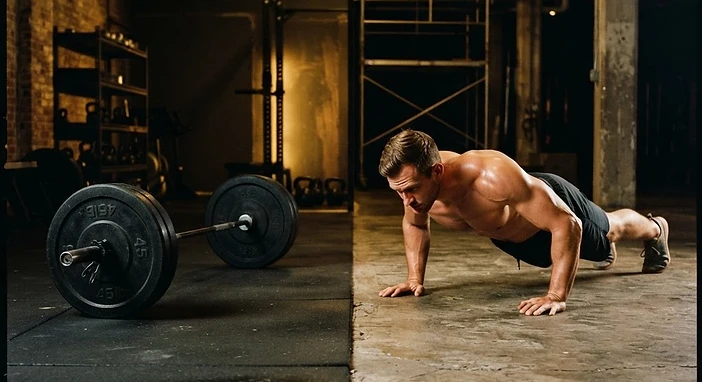
Calisthenics vs gym weights — both build real strength. Weights build it by adding load to a fixed movement; calisthenics builds it by making your own bodyweight progressively harder to move. The honest answer to which is better is: the one you will still be doing in six months. Here is how the two actually compare on equipment, cost, progression, and results, so you can pick with clear eyes.
What each style of training actually is
Calisthenics is strength training where the resistance is your own body: push-ups, squats, planks, lunges, and harder variations of each. You progress by moving to more demanding versions of a movement — knee push-ups become push-ups, push-ups become close-grip push-ups — not by adding plates.
Gym weights are external load: barbells, dumbbells, and machines. You progress by adding kilograms to the same movement, which makes progression precise and measurable, at the cost of needing the equipment itself.
The honest comparison
| Factor | Calisthenics | Gym weights |
|---|---|---|
| Equipment | None — a patch of floor | Barbells, machines, a gym |
| Cost | Free to train, forever | Membership or home setup |
| Where | Home, hotel, park, anywhere | Wherever the equipment is |
| How you progress | Harder movement variations, longer holds | More weight on the bar |
| Strength you build | Relative strength — moving yourself with control | Absolute strength — moving external load |
| Legs | Good, with lunges, squats, jumps | Easier to load very heavy |
| Skill ceiling | Very high — planches, levers, handstands | Very high — hundreds of kilos |
| Time cost per session | No commute — minutes count | Includes travel and setup |
Does bodyweight training build "real" strength?
Yes. A push-up loads your chest, shoulders, and triceps with roughly two-thirds of your bodyweight, and a one-arm version loads far more than a bench press would for most beginners. Muscles do not know where resistance comes from — they respond to tension. What weights change is not whether you get strong, but how precisely you can add resistance in small steps, and how directly you can load the legs.
What calisthenics gives back is relative strength: the ability to move and control your own body. That is the kind of strength soldiers train for, because on a march or an obstacle course nobody cares what you can bench — they care whether your body can carry itself. That is the style the military calisthenics workout tradition is built on, and what MILITRO borrows as a civilian program.
Who each one suits
Calisthenics fits you if
- You want to train at home with no equipment
- You travel or have an unpredictable schedule
- You have quit gym routines before because of the commute
- You want usable, full-body strength and joint control, not a bigger one-rep max
Gym weights fit you if
- You want precise, measurable progress on the bar
- Maximum leg strength is a specific goal
- You want machines that make some movements safer to load
- The gym itself is the habit that gets you out of the house
Can you combine both?
Yes, and many people do: bodyweight training as the consistent daily base, weights when you want to load a movement heavier. They are not rival teams. If you are starting out, though, the fastest results come from picking one structured plan and finishing it — the basics of push, squat, hinge, and brace appear in both worlds. If you have never followed a written plan at all, start with how to build a beginner calisthenics routine and decide the equipment question after 28 consistent days.
How the MILITRO kit helps
MILITRO is deliberately on the calisthenics side of this debate, because the challenge is built for one thing above all: consistency with zero friction. The kit gives you the ordered 28-day schedule, five movements a day in timed sets, week-by-week progression, and an easier option for every exercise — all with no equipment and no commute, so "I couldn't get to the gym" never happens. See how the plan is laid out in how the MILITRO 28-day plan works, or try a full session first with the free workout routine.
Frequently asked questions
Can you get as strong with calisthenics as with weights?
For general, full-body relative strength, yes. Bodyweight training builds genuinely strong muscles and joints, and most people never reach the point where bodyweight becomes too easy to keep progressing. Weightlifting makes adding resistance more precise, which is why powerlifters and bodybuilders at an advanced level usually use weights.
Is calisthenics enough for legs?
For general fitness, yes. Squats, lunges, split squats, and jumps build capable, defined legs. People chasing very large maximum leg strength, such as a heavy barbell squat, will eventually want external load.
Which is better for beginners?
Whichever one removes the most friction. Calisthenics needs no gym, no commute, and no equipment, which makes it easier to start today and keep going. A gym helps if you want coaching, machines, or a dedicated place to train.
Can I do the MILITRO challenge if I also go to a gym?
Yes. The challenge is a self-contained 28-day program that only needs floor space, so you can run it on its own or as a consistent daily base alongside gym sessions. If you feel worn out, keep the challenge and trim the gym work instead of skipping days.
Pick the one you will finish
The strongest people in either camp got there the same way: months of unglamorous, consistent sessions. Choose the style that removes your excuses, and the strength question takes care of itself.
No equipment. No commute. A 28-day plan that is hard to quit.
Get the MILITRO kit