Does Calisthenics Build Muscle? What Actually Happens Without Weights
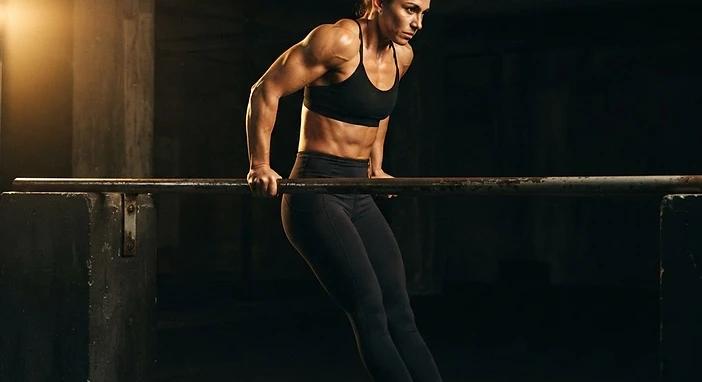
Yes, calisthenics builds muscle — provided the resistance is genuinely hard for you and it grows over time. Muscle growth is triggered by mechanical tension and effort, not by the presence of iron. A push-up loads your chest, shoulders, and triceps with most of your bodyweight; a harder variation loads even more. Your muscles respond to that tension the same way they respond to a barbell. What changes is only how you keep the tension growing.
How muscle growth actually works
Every muscle grows by the same three-part mechanism, regardless of the tool:
- 1. Tension. The muscle works hard against resistance — close to the limit of what it can do with clean form.
- 2. Recovery. Food and sleep give the body the material and time to repair.
- 3. Overload. Next time, the work is slightly harder than last time, so the adaptation keeps happening.
A dumbbell is one way to create tension. Your own bodyweight is another. The sentence "you need weights to build muscle" confuses one tool with the underlying requirement, which is hard, progressing tension.
Why bodyweight counts as real resistance
When you do a push-up, your arms are pressing a large share of your total bodyweight. When you do a squat, your legs are lifting you against gravity through a full range of motion. For a beginner — and honestly for most people — that is plenty of load. If a standard movement becomes easy, the variation system takes over: knee push-ups become push-ups, push-ups become close-grip push-ups, then pike push-ups, then harder still. Each step re-loads the muscle, which is exactly what a bigger plate does in the gym.
The one honest limitation: adding 2.5 kg to a bar is a precise 2.5 kg. Moving to a harder variation can be a big jump, which is why good bodyweight programming uses timed sets and tempo so you can scale inside a movement. That is how the military calisthenics tradition has always done it.
How to keep progressing without weights
- Harder variations: move to the next version of the movement once the current one stops being difficult
- More time: longer holds, more sets, or more reps of the same movement
- Slower tempo: a 3-second lowering phase makes the same rep much harder
- Cleaner form: full range with control beats extra half-reps every time
If your training includes at least one of those levers every week, your muscles have a reason to keep growing. If your routine has not changed in three months, neither will your body — that is true with or without weights.
What results are realistic?
With consistent training and enough food, beginners typically feel real strength changes within two to four weeks and see visible changes in eight to twelve. Calisthenics tends to build a lean, athletic look — visible shoulders, chest, and arms alongside capable legs — because bodyweight training burns energy and rarely leads to the kind of eating that maximizes sheer size. What it will not do is turn you into a mass-monster; that is not what the style is for. If someone promises a dramatic transformation in 28 days, treat that promise with suspicion — a structured month builds the habit, the strength, and the visible beginning, not the end.
How the MILITRO kit helps
The kit is built around exactly the mechanism described above: hard, progressing tension with no equipment. Every training day gives you five movements in timed sets, and every movement has an easier variation so the tension is right for your level on day 1 — then the schedule grows it: holds lengthen from 2 sets of 20 seconds in week 1 to 3 sets of 30 seconds in week 4, and the movements themselves get more demanding week by week. That is progressive overload, planned out for you. See how the 28-day plan works, or read calisthenics vs gym weights if you are still choosing a style.
Frequently asked questions
How long does it take to see muscle from calisthenics?
Most beginners feel the difference in two to four weeks and see visible changes in eight to twelve, with consistent training and adequate food. Timelines vary with starting point, genetics, and diet — be skeptical of any program promising a specific physique in a month.
Can you build muscle without any equipment at all?
Yes. Push-ups, squats, lunges, planks, and their harder variations provide real resistance. The key is that the work must feel hard — close to the limit of what you can do with clean form — and it must get harder over time.
Do I need to change my diet to build muscle?
Training is the signal; food is the material. Eating enough protein and not being in a large calorie deficit both matter for muscle growth. You do not need anything exotic — a normal, protein-rich diet supports beginner bodyweight training well.
Is calisthenics enough long-term, or will I need weights?
For general strength and physique, bodyweight training can keep you progressing for years, because every movement has a harder variation waiting. People with very specific goals, like a maximum deadlift, will eventually want external load.
Start the first four weeks
Muscle growth rewards the person who shows up. The kit removes every decision except the training itself: the plan is written, the progression is scheduled, and every movement has an easier option so you never stall.
Four weeks of planned progression. Zero equipment.
Get the MILITRO kit